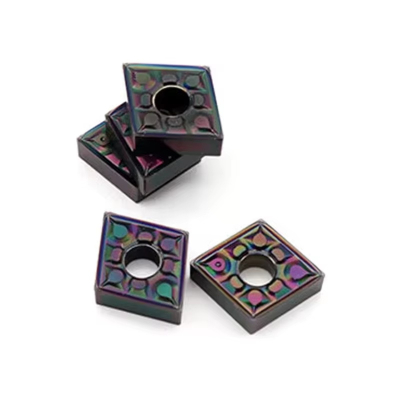
1. Tool Material Selection: Core Logic of Performance Matching
The performance of CNC cutting tool materials directly determines the upper limit of machining, requiring precise matching based on workpiece properties and cutting conditions. High-Speed Steel (HSS) has outstanding toughness and low cost, with the highest bending strength among all tool materials. It is suitable for medium-to-low speed cutting of soft materials such as aluminum and copper, but its heat resistance temperature is only 600-700°C, and its wear resistance is relatively poor—making it less ideal for high-volume hardened steel machining.
Cemented carbide (often called tungsten steel tools in industrial contexts), based on tungsten carbide (WC), has a hardness of over HRC80 and a heat resistance temperature increased to 800-1100°C. It is the main choice for high-speed cutting of medium-to-high hardness materials like steel and cast iron. Models with high cobalt content are suitable for rough machining, while those with low cobalt content are adapted for finish machining— a key detail for how to choose carbide tools for precision parts. Ceramic tools have a hardness exceeding HRC90 and a heat resistance temperature of 1100-1200°C, with better thermal shock resistance than diamond. They are ideal for dry cutting of high-hardness cast iron and hardened steel, but they are relatively brittle and need to avoid high-impact working conditions. Among superhard materials, Cubic Boron Nitride (CBN) has the highest heat resistance temperature (1300-1500°C) and low chemical affinity with steel, making it suitable for hard surface machining of bearing steel and die steel. Diamond tools have the highest hardness and excellent thermal conductivity, specially designed for ultra-precision machining of aluminum and glass, but they must avoid ferrous materials to prevent chemical wear—a critical note for diamond tool application in non-ferrous machining.

2. Differences in Tool Parameters for Mainstream Machining Processes
Different CNC machining processes have significant differences in requirements for tool structure and parameters. In turning processes, tools need to adapt to the rotational cutting characteristics of workpieces. The rake angle is usually small to ensure stability, and the relief angle is relatively large to reduce friction. TiAlN coating is commonly used to improve wear resistance, and the cutting speed needs to balance efficiency and tool heat resistance. For example, when machining 45# steel, the cutting speed of cemented carbide turning tools should be controlled at 80-120 m/min to balance efficiency and service life— a key parameter in optimal cutting speed for 45# steel turning.
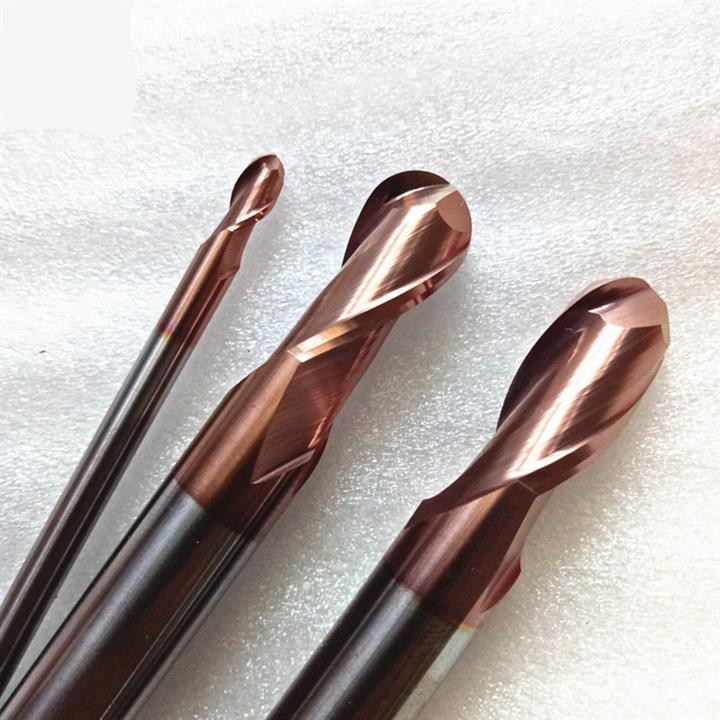
In milling processes, which rely on multi-edge cutting, tool geometric parameters are more complex: the helix angle directly affects cutting stability. A high helix angle design can reduce vibration and improve chip evacuation—essential for vibration-free milling of mold components. End mills usually use a helix angle of 30°-45°, while face mills can increase it to 60°; tungsten steel ball nose end mills with 45° helix angles are particularly effective for 3D curved surface machining. During drilling processes, the tool load is concentrated, and the tool tip angle is mostly 118°-140° to reduce cutting force—118° for soft metals like aluminum and 135° for self-centering in steel, as explained in drill tip angle selection guide for different materials. For deep hole machining, drills with a spiral groove design should be preferred, and an internal cooling system should be used to discharge chips. The cutting speed of cemented carbide drills is 3-5 times higher than that of HSS drills, a advantage highlighted in how to improve deep hole drilling efficiency with carbide tools.

3. Coating Technology: A Key Means of Performance Upgrade
Coating technology realizes the performance leap of CNC cutting tools through surface modification, with PVD vs. CVD coating comparison being a common concern for manufacturers. Mainstream technologies are divided into two categories: Physical Vapor Deposition (PVD) and Chemical Vapor Deposition (CVD). PVD coatings are prepared in a high-vacuum environment with strong film adhesion, suitable for high-precision milling and turning scenarios; the commonly used Titanium Nitride (TiN) coating (Hv2800 hardness, 0.3 friction coefficient) is a universal choice for general machining .
CVD coatings are deposited through high-temperature chemical reactions, with thicker film layers and better heat resistance, suitable for high-temperature heavy-duty cutting conditions. Targeted coating materials have their own strengths: Titanium Aluminum Nitride (TiAlN) coating (800°C heat resistance) reduces wear in stainless steel machining; Chromium Nitride (CrN) coating excels in high-temperature continuous cutting; the new generation TiSiN nanocomposite coating (5-10 nm grain size, HV3500 hardness) extends service life by 1.5 times in superalloy machining . Emerging options like CemeCon HYPERLOX® ultra-nitride coating offer high toughness and oxidation resistance, ideal for 淬硬钢 and high-strength material machining . Coating selection must avoid material conflicts. For example, diamond coatings cannot be used on cemented carbide substrates (thermal expansion mismatch causes cracking); CBN tools need no extra coating (sufficient inherent hardness). For aluminum, DLC coatings reduce built-up edges; for cast iron, TiC coatings enhance wear resistance—key insights for how to match tool coatings with workpiece materials.
4. Matching Principles for Coatings and Materials
The complementary performance of coatings and substrate materials is the key to exerting their effectiveness—a core topic in CNC tool performance optimization. HSS tools coated with TiN see 2-3x improved wear resistance, meeting medium-speed cutting needs; cemented carbide + TiAlN coatings boost heat resistance from 900°C to 1100°C, expanding high-speed steel machining capabilities. Ceramic tools + Si3N4 coatings enhance thermal shock resistance, reducing dry cutting thermal cracking risks.
Avoid common mistakes: diamond coatings on carbide substrates cause cracking (thermal expansion mismatch); unnecessary coatings on CBN tools lead to peeling. For specific scenarios: AlCrN-coated carbide inserts for titanium reduce friction; HT-TiCN coatings suit dry milling of alloy steel ; oxidation coatings extend uncoated tool life by over 50% in soft material machining . These rules answer the critical question: what coating works best for my CNC tool and material?